‘I was expecting to see Mr Jeremy Fisher’: The whimsical Kent lane that made me abandon my sat nav

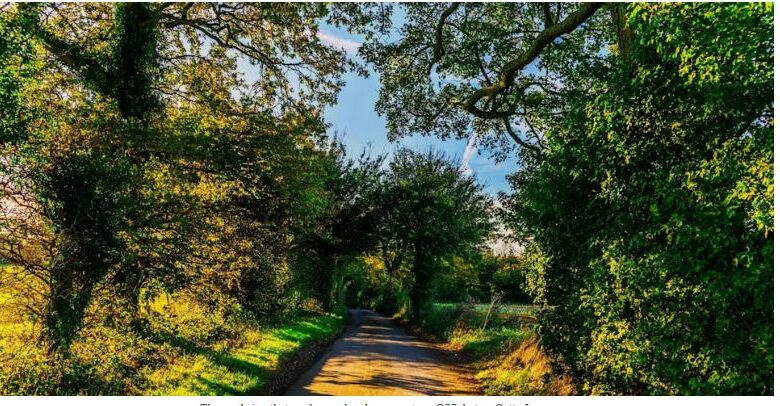

It happened on an ordinary drive through the Kent countryside. I wasn’t looking for a beauty spot and my sat nav certainly wasn’t suggesting a detour. Then I spotted a weathered road sign pointing down a narrow, tree-lined lane near Cranbrook.
Frogs Hole Lane.
Before I’d really thought about it, I was indicating.
The lane curved gently between high hedgerows and disappeared beneath the trees, with sunlight dappling the road. For a moment, I expected Jemima Puddle-Duck to waddle around the next bend – or perhaps to find a community of frogs living beside an old pond.
There wasn’t a grand attraction waiting at the end. In many ways, that was the point. It was simply a beautiful country lane, and I would have driven straight past it had it not been for its wonderfully evocative name.

It turns out I’m not the only one charmed by an unusual address. My colleague Lottie grew up on one herself — Witts End in Eversholt, Bedfordshire — and its name has caused plenty of confusion over the years.
“Growing up on Witts End, I’ve had lots of people ask about the name,” she says. “Delivery drivers often double-check it and laugh once they realise.
“My mum once told a delivery driver over the phone that she was on Witts End. He thought she meant she was at her wits’ end and asked her not to get in such a huff. Thankfully, it was soon cleared up and they both laughed about it.”
Witts End is a narrow country road with no pavement, bordered by paddocks where horses and, occasionally, sheep graze. At some points, there is only enough room for one car.
One house is known for the foxgloves that surround it, while another was once a pub and still has the old metal frame from which its sign hung. Lottie’s own home was formerly a chapel.
“It feels very boastful to gush about my village, but I love it,” she says.
Eversholt itself was recorded in the Domesday Book in 1086, and its name is believed to mean “boar’s wood”. Exactly how Witts End acquired its memorable name, however, remains a mystery.

Between Frogs Hole Lane and Lottie’s stories of life on Witts End, I started wondering how many other real places have names that make you imagine who – or what – might live there.
I went down something of a rabbit hole and found more wonderfully whimsical names scattered across rural Britain – from tiny hamlets and Dales villages to country lanes disappearing into open farmland. Take a look at them below:
Pixey Green, Essex
Just outside Saffron Walden, Pixey Green is little more than a handful of homes, but its enchanting name makes it difficult to pass without wondering who might live there.
Its exact origins are uncertain, and the name is thought to have more earthly roots than the mythical creatures it brings to mind. Even so, it’s the kind of road sign that might make you check the rear-view mirror.
Dragon’s Green, West Sussex
Dragon’s Green is a small rural hamlet in the parish of Shipley, between Horsham and Billingshurst.
Its residents may not have to contend with fire-breathing neighbours, but the name is enough to make passing drivers slow down for a second look. Appropriately, the hamlet is also home to a pub called The George and Dragon.
Fairy Glen, North Yorkshire
With a name like Fairy Glen, it is hard not to picture some rather elusive inhabitants.
Moss-covered rocks, tumbling water and a leafy canopy give this secluded rural spot a suitably magical atmosphere. Even the most practical visitor might find themselves checking beneath the leaves.
Sprite Lane, Lincolnshire
On the edge of Billinghay, Sprite Lane runs out towards the surrounding Lincolnshire farmland.
Long before it became the name of a fizzy drink, a sprite was a mischievous spirit or fairy. With fields stretching away from the village, it’s the sort of name that makes you wonder what might be hiding in the hedgerows.
Appletreewick, North Yorkshire

Appletreewick – pronounced App-trick – sounds as though it should be populated by apple growers and rosy-cheeked cider makers.
Its name comes from Old English and Old Norse and refers to a dairy farm associated with apple trees. Today, the Yorkshire Dales village is home to handsome stone cottages, riverside walks and glorious countryside.
Cold Christmas, Hertfordshire
Cold Christmas, near Ware, is one of those names that immediately makes you wonder about its residents.
Do they keep their decorations up all year? Does snow settle there before anywhere else? And does every Christmas card sent to the hamlet come with the same joke?
The real origin of the name is uncertain, which for me only adds to its appeal.
Has a place name ever hijacked your journey?
Has a road sign ever persuaded you to abandon your planned route and explore? We’d love to hear about the rural roads, lanes, villages and hamlets whose names made you wonder who – or what – might live there.